Saturday, 4 May 2019

Looking for an intergeneric hybrid more in hope than expectation

I still have not given up on the search for the putative intergeneric orchid hybrid - the cross between Green-winged orchid (Anacamptis morio) and Early purple orchid (Orchis mascula).  I am very doubtful, as is much of the literature, about whether it exists in the wild in Britain though there are a few, old, records on the BSBI database, the most recent from 1985 from Arnside made by a reliable recorder, and recently I saw a picture of this plant. Even so, I am not sure if I was convinced.   

Both are pollinated by bees, including bumblebees, but both show low rates of pollination success (20 to 30% seed set for Green-winged and around 10% seed set for Early purple), not surprising perhaps given that they flower early.   In addition there are possibly reproductive barriers to cross fertilisation.

Last Sunday I went to Minchinhampton Common and then to Selsley Common in Gloucestershire where both are intermingled looking for plants that ideally had spotted leaves (characteristic of early purple, though not always) and veining on the sepals (characteristic of Green-winged) even if just a hint.   I found nothing, and so to another site yesterday near Snowshill, around 20 miles from Hooky, to what looked like an old quarrying area.   The same story, despite looking at perhaps more than a hundred plants - at least - where both parents were close together, dwelling on a handful, but concluding that they they fell on one side of the fence or the other.  


Early Purple Orchids

Early Purple Orchids

Green-winged Orchid

Green-winged Orchid

A few colour variations of both were interesting but the highlight undoubtedly was the twenty or so plants of Pasqueflower (Pulsatilla vulgaris) and lots of Meadow saxifrage (Saxifraga granulata).


Pasque Flower

Pasque Flower

Meadow Saxifrage

Meadow Saxifrage

Sunday, 14 April 2019

Hook Norton's Grape Hyacinths

I took part in the annual count of Muscari neglectum in and around Chadlington by the Wychwood Flora group on Friday   I have not seen the final count yet but my impression was that it was a 'good' year for flowering plants.   Muscari neglectum is the recognised native species of Grape hyacinth, with its distinguishing dark navy to violet black flowers beneath a few sterile blue flowers at the top of the spike,  compared to the royal blue of the garden plant, Muscari armeniacum, an introduction from south eastern Europe.

Muscari neglectum held up against a group of M. armeniacum 

Druce's Flora of Oxfordshire gave several locations for Muscari neglectum in the early 20th century but now I think it is restricted to Chadington.   It is nationally rare.  

Well it also occurs in Hook Norton, and I spotted the plant in a display at the village garden society annual show yesterday (which won first prize in its class).  I went to the garden from which it came and then continued round the village, finding the plant in several gardens and overflowing into verges, not unlike Chadlington.   They are not cultivated in any of the gardens, they are just there, sometimes profusely in amongst grass.   

There are four hotspots in the village, the common thread being that all are in gardens which have been around for at least 100 years - The Bourne and Bourne Lane especially where the houses back on to what used to be allotments, the East End, Park Hill and near the Brewery, where there are also what look like plants intermediate between the two species.  The only question is therefore  whether it was introduced into gardens or occurred in surrounding farmland in the 19th / early 20th century, and crept in as a weed.  I rather fancy we will never know.

Near the Brewery

Park Hill


Tuesday, 9 April 2019

Snails and butterfly orchids at Greenfield

I went to Greenfield in the Chilterns yesterday.  The greater butterfly orchids are now emerging and recognisable, but they have suffered significantly from snail attack over the last month.   In some cases the entire growing tip has been eaten off.

The effect of snail damage can be summarised as follows. There were 92 numbered plants in what we term the study section last year, and I added a further 4 yesterday, bringing the total up to 96.  Of these:

Nothing above ground     28  (maybe at least partly due to snails)
Chewed but plant visible  15

Recognisable leaves        53
 of which 3 leaves             2
              2 leaves           29
              1 leaf               22


Of those with recognisable leaves 24 out of the 53 had suffered some snail damage.    The landowner put slug pellets down after my visit to try to curtail further damage.   This is one of the snails found in the laef litter


The snail damage has been much more severe than last year, probably because the spring has been mild and reasonably damp, whereas last year March and April were colder than normal, but then I do not know much about snail ecology, which for anyone studying orchid populations seems increasingly important.

In the north enclosure, where there were 258 plants last year including juveniles, I put bamboo stakes by the emerging plants, and removed by hand as much of the Dog's mercury as possible around the emerging plants so they do not get overwhelmed as happened last year.   I did not make a count but there were around 150 stakes.  Because only a few of the plants are numbered it will be impossible to pick up on losses from snails but I am sure the worst impact is in the south where the leaf litter is deeper, because there are two large beech trees overhanging the area.    

On a slightly better note, the orchids are spreading beyond the two enclosures, and I counted 40 plants in an area over which I put the brush cutter a month ago.

Next year we might consider taking off some of the leaf litter, but it may be beneficial to the germination and development of new plants.   I don't know!


Saturday, 6 April 2019

Plants around Epwell using the iRecord App


Despite being a member of BSBI since the early 1990s when you almost had to get someone to give you a reference before you could join,  I have made a minimal contribution to the Society's Atlas 2020 recording programme, where minimal equals zero.   Atlas 2020 is a follow up to plant distribution atlases in Britain and Ireland, first prepared in the 1960s and again in 2000.  The north of the county is under-recorded because of a lack of botanists, and frankly because it is actually quite dull.

I am only half a botanist; I can recognise a fair number of plants but know only a few of the scientific names.  Presented with a recording sheet where all the names are abbreviated Latin names is just not something I can cope with.   However the iRecord App makes life much simpler.  Plant lists are easy to create either by inputting common names or the scientific names and of course it automatically stores location data.   I tried it out yesterday on a walk from Sibford Gower to Epwell, two villages to the north of Hook Norton, sticking to paths across fields plus a wander around Epwell.

Ditchedge Lane
 I came up with just under 60 plant species, none of which were noteworthy.   But the App proved effective.  The only downsides were that it was heavy on the phone battery, and I was not able to download my list of plants before I submitted the records to the central database.  Once submitted  a list could then be extracted.

Field Pansy (Viola arvense)

Ivy-leaved Speedwell (Veronica hederifolia)
 Probably the nicest find though was this micromoth, which I think is Agonopterix heracliana.

Agonopterix heracliana

Wednesday, 3 April 2019

Toothwort and Violets

Giving priority to redecorating a bathroom I missed the annual count of flowering Yellow Star-of-Bethlehem plants at Whitehill Wood two weeks ago.   To catch up I went there yesterday, but found only 2 flowering plants, (cf the official count's 10 flowering plants) spotting made difficult by the conditions - rain - and the flowers were well past their best.   On my 5m test strip I counted 46 plants from the path to the river, and 47 1 metre back from the path.  There were no flowers.  Most were juvenile plants with very narrow leaves; one of the flowering plants further away had by contrast a leaf of width 8.1mm.   

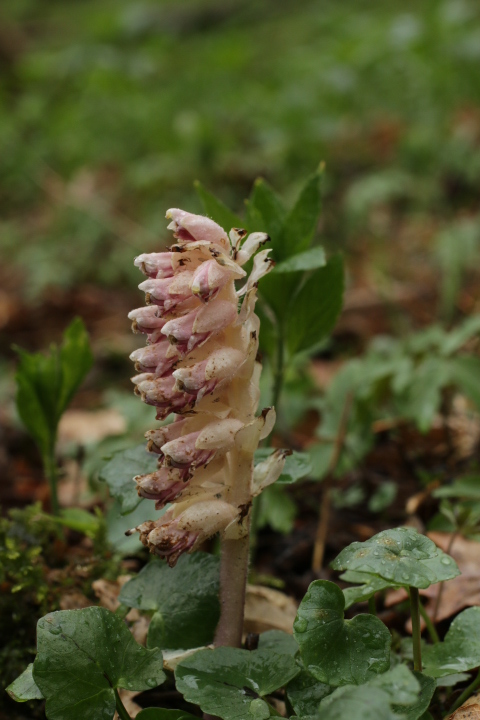
However the later visit meant that the attractive parasitic plant, toothwort (Lathraea squamaria) which is easily seen there, was in full flower.  
Toothwort

Early Dog-violet

Yellow Star-of -Bethlehem

There were lots of violets, almost all surprisingly early dog-violets (Viola riechenbachiana).  Closer to home the commonest violet seems to be sweet violet (Viola odorata), both the purple and white forms.   I did find one which was part way between these two colour forms.

Mixed colour form of Sweet violet


In the wood near Park Farm I found this alien corydalis which I think is Bird-in-a- Bush (Corydalis solida):

Bird-in-a-Bush

Muscari are everywhere at the moment, but I am convinced that in quite a few of the gardens and verges around the village they are Muscari neglectum, the scarce native plant (which is thought to be naturalised in Oxfordshire eg at Chadlington), rather than Garden grape hyacinth (Muscari armeniacum).  An example from Park Hill, in the village:

Muscari neglectum

Sunday, 10 March 2019

Habitat work at Greenfield

I had a day out in the Chilterns on Friday and did some modest work on the two butterfly orchid enclosures at Greenfield.  The first leaves of the orchids were just visible, poking through leaf litter, and reaching around 3cm. 

Plant #85


Plant #203
Plant #100


Plant #77
Plant #209

Of the five plants illustrated, chosen at random, only one flowered last year (plant #100).  It might not repeat flower because it was not a particularly robust plant.  By contrast plant #85 did not flower but should do this year - its leaves were broad in 2018, a good indicator of what might transpire in the year following.  Plant #77 had 2 leaves last year, and although plant #203 had only one leaf then, it is obvious that it will have 2 leaves this year.  Plant #209 showed up early in 2018 but had disappeared by June when the full count was made.   It looks a little feeble.

The northern enclosure in 2018 had a thick sward of Dog's mercury which almost overwhelms the orchids.   It seems to be getting more aggressive, perhaps because more light is getting in with the ash trees suffering from ash die back. The problem it creates is that it smothers orchid leaves post-flowering, and chokes out light reaching them thus hampering the development of next year's tuber To check it, I strimmed the emerging plants and hand pulled bits that I missed.  This approach works on bracken; time will tell if I will have had any impact on Dog's mercury.

Before

After
Last year we had an increasing number of plants spreading outwards from the enclosures.  To encourage this spread I put a brush cutter over these areas.

Sunday, 3 March 2019

February Firsts

The warm and sunny period at the end of February brought about a rush of firsts of the year in my part of Hook Norton.

First moth:  Spring Usher. 


A new species for me, bringing my Hook Norton total since 2016 up to 243 species.   Last year we had 151 species, and in 2017 150 species, but with a lot of differences within those totals.
First butterfly: Brimstone
First hoverfly: Eupeodes luniger (on crocuses)


First bats: Common pipistrelle, (according to my Echometer Touch2) though the echolocation calls were atypical.  A spectrogram from February is compared below to one from October for a Common pipistrelle.  The former might in fact be a Soprano pipistrelle, but even then the spectrogram is odd with a bimodal pattern (at 50 kHz and 25kHz).  Maybe this has something to do with emerging from hibernation but I have to admit that I am baffled, and I did think it would be easy!


 Common pipistrelle? (Feb)    Definite Common Pipistrelle (Oct)